
Duval VINELink Changed to IVSS
Texas changed its county notification channel on September 1, 2025. The Texas Attorney General transition notice directs county users from VINE to Texas IVSS-Counties. Existing registrations were transferred, and users were told to update passwords and review preferences. Phone and text delivery moved to the new provider.
Legacy VINELink instructions remain common in search results. They are no longer the authoritative 2026 county workflow. The older Texas VINELink address may explain an old bookmark or redirect, but a current Duval County Jail check belongs in IVSS-Counties if the live portal shows Duval participation. The research did not obtain a public result proving current Duval feed coverage, so participation must be confirmed inside the portal.
The current county portal is pictured below. Open the live IVSS-Counties portal to confirm the fields and agencies offered at the time of the check.
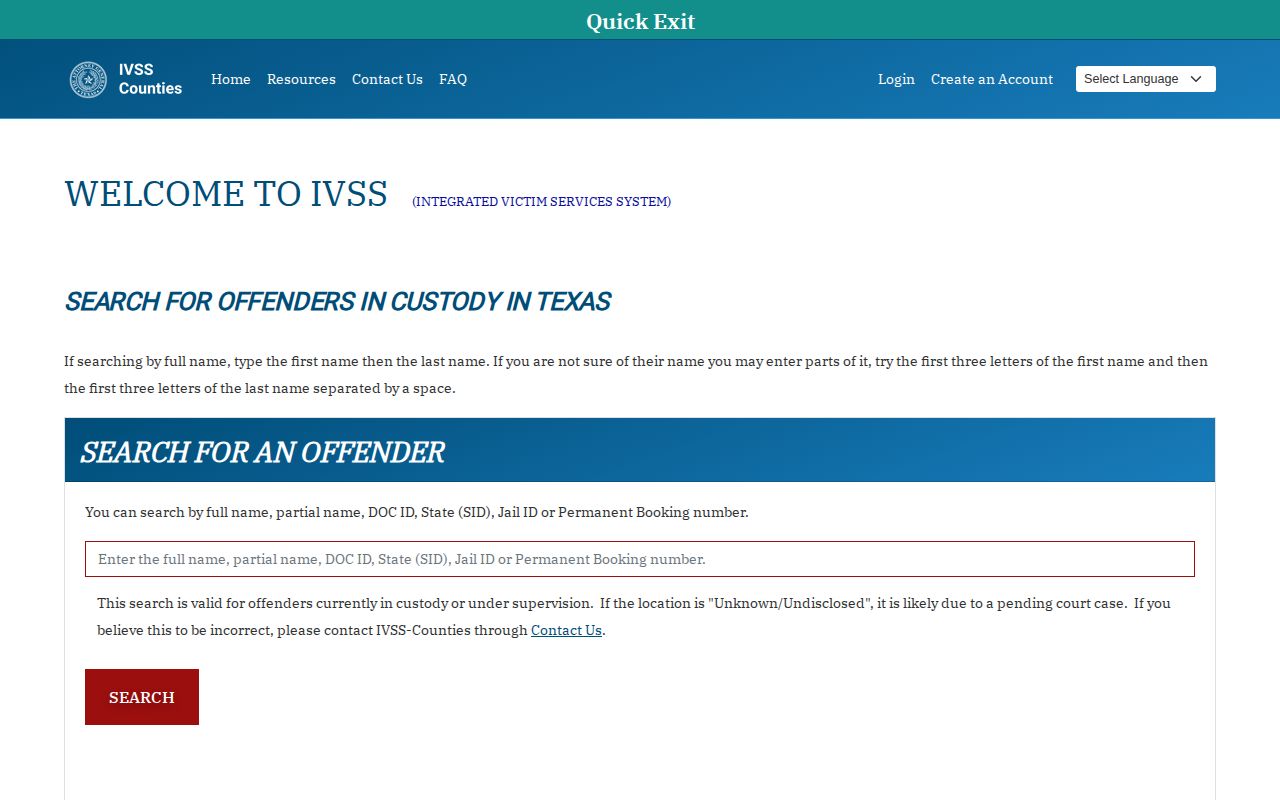
The interface determines current participation and search options. A screenshot cannot guarantee future coverage.
Choose the Duval Notification System
Custodian choice comes first. Duval County Jail is operated by the sheriff. Ernestine Glossbrenner Unit is a TDCJ treatment facility, not the county jail. A person can leave the jail through a community release or transfer into TDCJ, including placement at or beyond Glossbrenner. A county registration may therefore need a new state registration after transfer.
| Custody or event | Notification path |
|---|---|
| Duval County Jail episode | IVSS-Counties when Duval participation appears |
| TDCJ prison or SAFPF custody | TDCJ IVSS |
| Parole or mandatory supervision event | TDCJ IVSS and TDCJ status channels |
| Federal prison | BOP locator, not either Texas county portal |
| Immigration detention | ICE custody channels, not IVSS as a substitute |
If the custodian is unknown, request the Duval sheriff's destination or accepting-agency field. Then move to the receiving system. Do not search every portal and merge similar names without an identifier.
Search a Duval County Person
A notification search is for one specific person. Use the exact name and a second identifier when the live interface offers one. Always inspect jurisdiction and reporting agency before opening a result.
- Choose IVSS-Counties for a Duval jail episode or TDCJ IVSS for state incarceration, parole, or mandatory supervision.
- Enter the exact name. Add an agency or offender identifier, birth detail, or other field when offered.
- Confirm Duval County, Texas and the correct custodian. Reject Jacksonville, Florida results.
- Open the matching record and read the displayed custody status, agency, event date, and location.
- If “released” appears, contact the sheriff for the county release type and destination or TDCJ for actual release and supervision status.
- If no match appears, treat it as inconclusive. Check spelling, agency participation, transfer, and direct custodian records.
Similar names can produce the wrong person. Keep the searched identifier and reporting agency with the saved result. A notification record should be joined to a sheriff booking number or TDCJ number, not just a name.
Duval IVSS Result Fields
Fields vary by portal, agency, status, and interface version. Record what the live result actually shows rather than promising a fixed VINELink field set.
| Field | How to read it |
|---|---|
| Name or identifier | Confirms which person and agency record matched. |
| Reporting agency | Identifies the custodian that supplied the event. |
| Custody status | States the source agency's current or event status. |
| Event type | May distinguish release, transfer, parole, discharge, or another change. |
| Event date and time | Dates the reported change but may not show every processing step. |
| Location | Shows the listed facility or agency when available. |
“Released” means the reporting agency sent a release or custody-change event. It does not independently prove that the case was dismissed. County release can mean transfer. TDCJ release from prison can lead to parole or mandatory supervision, while discharge means completion of the sentence or supervision stated by the record.
- Parole
- Conditional community release after a Board decision, with supervision continuing.
- Mandatory supervision
- A statutory form of supervised release governed by Texas eligibility and Board rules.
- Transfer
- Movement to another custodian, not release from all custody.
- Discharge
- Completion of the controlling sentence or supervision.
Register Duval Release Alerts
Registration must follow the choices shown by the current portal. Do not reuse the former VINE four-digit PIN procedure unless the live IVSS interface actually asks for it. The Texas transition changed account and delivery mechanics.
- Create or sign into the appropriate IVSS account.
- Select the confirmed person and reporting agency record.
- Choose the custody, release, transfer, parole, discharge, or Board events the portal offers.
- Add an offered phone, text, email, letter, or other delivery channel.
- Complete the current contact-verification step and retain confirmation.
- If a VINE registration migrated, update the password and review every preference and contact method.
TDCJ IVSS lists email, letter, text, and phone delivery. Its service contact is (800) 848-4284. Availability can differ from the county portal, so do not assume that selecting an event in one system registers it in the other.
The separate state portal image below supports the TDCJ notification route. Visit TDCJ IVSS for the live state workflow.
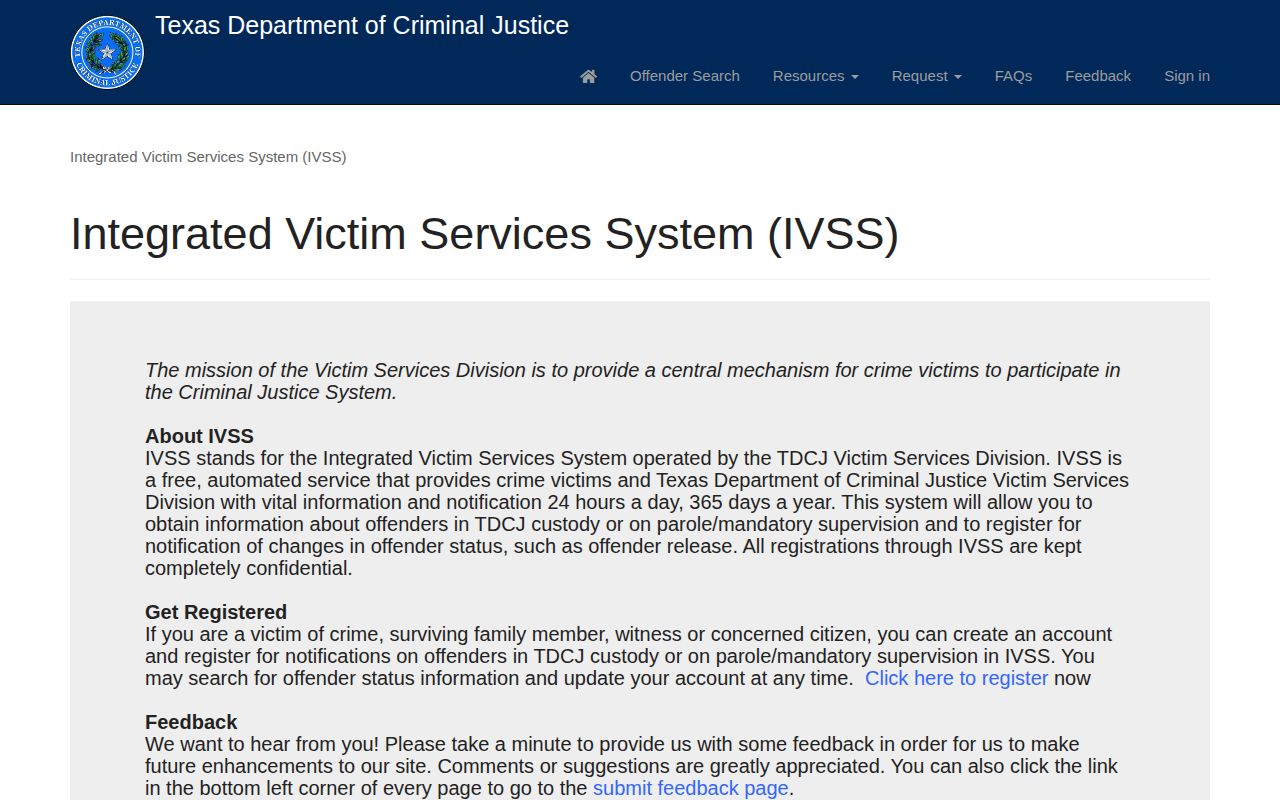
This state system follows TDCJ events and does not replace a sheriff release record for a Duval jail booking.
Verify Duval Release Alerts
Notification services depend on data supplied by participating agencies and delivery systems. An alert can lag, fail to arrive, or reflect only one custodian. Do not make a time-sensitive safety decision from the notification alone. Contact the agency that created the event.
For a Duval County Jail release, ask the sheriff for release type, timestamp, releasing authority, and destination. For TDCJ, compare the offender status with the actual release and supervision record. A projected or scheduled date is not the same as completed release. Use Inmate Release Date to understand those date fields.
A no-match result is also limited. It may reflect spelling, missing participation, transfer, delayed intake, interface rules, or a record that is not public. Follow the Duval County released inmate search when IVSS does not resolve the correct custodian.
Note: Save the result time and agency because custody can change after the event shown.
Two Duval Release Alert Layers
Duval County's local and state facilities make the two-layer system especially important. The sheriff jail and Glossbrenner can both appear in a person's path, but they answer to different custodians. Leaving the jail for TDCJ closes one local stage. It does not prove state release. Leaving Glossbrenner may be a treatment or supervision transition rather than full discharge.
When the county record says TDCJ accepted custody, retain the Duval booking number and accepting-agency information. Find the TDCJ number after intake, then create the state notification registration. If TDCJ later reports release, read whether supervision follows. Keep the county and state event records as separate links in the timeline.
This separation also prevents a stale county alert from being read as present status. The last county event can remain valid as history while a later state event controls the current answer.
Review Migrated Duval Alerts
A former VINE registration should not be assumed complete after migration. Sign in through the current county portal, update the password if requested, and inspect the person, agency, event choices, contact methods, and delivery preferences. Old phone or email data can make a technically active registration useless. Preserve the new confirmation screen or message after each correction.
Check whether the registered record still points to the custodian that now holds the person. A county record may stop being the useful layer after transfer to TDCJ. In that case, keep the county event as history and establish a separate TDCJ IVSS registration. The state registration should use the TDCJ identifier and events offered by the state system.
Do not state that an old four-digit VINE PIN remains required. The research identifies that method as legacy. Follow only the verification steps displayed by the current portal. If the interface does not show Duval or does not return a sound match, call the sheriff rather than forcing a registration against the wrong county.
Confirm Duval Notification Events
Build a short evidence chain around each alert. First identify the reporting agency. Next record the event type and time. Then obtain the operational source record. For a county event, that is the sheriff release or transfer entry. For a state event, it is the TDCJ status and actual-release information. Finally, check the court or supervision record when it explains the legal authority or continuing conditions.
| Alert wording | Required confirmation |
|---|---|
| Released | Ask whether it means community release or transfer and obtain the destination. |
| Transferred | Identify the accepting agency and confirm intake there. |
| Parole event | Read the Board or TDCJ status and verify the supervising office. |
| Discharge | Confirm which sentence or supervision term ended. |
A favorable parole vote or a future date is not a completed physical release. Processing, program conditions, detainers, or new information can affect the result. Keep notification wording intact and avoid replacing a narrow event label with a broader conclusion.
Delivery time and event time can differ. Save both when shown. A late message does not change when the reporting agency says the event occurred. If two channels deliver different wording, contact the source agency and request the underlying event record.
Review alerts after any transfer, new booking, release, or discharge. Keep county and TDCJ notices tied to the correct custody stage.