
Duval County Release Date Meanings
The Texas Department of Criminal Justice can display several dates that answer different questions. Its official definitions should control how each label is read. Projected release is a time-credit and statutory projection. Parole eligibility is the first point when the release authority may consider a qualifying case. Maximum sentence date is the term endpoint under the current record calculation.
Scheduled release date and scheduled release location appear after approval and operational processing reach that stage. Even then, they can change. Actual release is the completed event. Discharge is different again: it means the sentence or supervision described by the record has ended. A person can be released from prison to parole and remain under supervision without being discharged.
| Date field | What it answers |
|---|---|
| Projected Release Date | Current projection based on governing rules and recorded credits. |
| Parole Eligibility Date | First possible review point under the applicable law, not a release promise. |
| Maximum Sentence Date | Calculated endpoint of the term shown in the state record. |
| Scheduled Release Date | Operational date after approval and records processing. |
| Actual release | Completed departure event confirmed after it occurs. |
| Discharge date | Completion of the controlling sentence or supervision. |
Choose the Duval Date Source
Duval County has two systems that are easy to confuse. Duval County Jail is a local sheriff facility. Ernestine Glossbrenner Unit is a TDCJ Substance Abuse Felony Punishment Facility. The sheriff executes local judgments and records county release or transfer. TDCJ calculates state fields and processes state release.
A pretrial detainee usually has no projected sentence-release date because the case has not produced a sentence. Bond, dismissal, court order, plea, or trial can change the custody path. Ask the sheriff for current status and inspect the court file. A person serving a county-jail sentence requires the judgment, court-certified jail credit, sheriff time sheet, applicable county-jail credit rules, and other holds. Duval publishes no local calculator or good-time policy.
A TDCJ inmate belongs in the TDCJ Online Inmate Search. County of conviction does not determine the unit, and Glossbrenner placement does not make the sheriff responsible for the state calculation. If a Duval jail record shows transfer to TDCJ, allow for intake processing and confirm the TDCJ number.
| Situation | Primary date source |
|---|---|
| Pretrial at Duval County Jail | Sheriff status plus court bond and case orders |
| County-jail sentence | Judgment, certified credit, sheriff time sheet, and holds |
| TDCJ prison or SAFPF placement | TDCJ search, Classification and Records, and Board status |
| Federal sentence | BOP records rather than a Texas calculation |
Find a Duval Projected Date
Search only the system that holds the record. Keep identifiers and the check date with the result because calculations can change.
- Identify the custodian from the Duval booking record, TDCJ number, court commitment, or receiving-agency destination.
- For TDCJ, search by exact name and identifier. Open the matching record and record projected release, parole eligibility, maximum sentence, current unit, and offense rows as displayed.
- For a county sentence, obtain the signed judgment, sentence, jail-credit entry, and sheriff time or release record. Ask about other holds.
- Read the offense date and offense statute. They determine which parole and mandatory-supervision rules can apply.
- For TDCJ cases, read the current Board vote code and any program condition. Approval can be contingent and is not physical release.
- After approval, confirm the scheduled date and location through TDCJ status channels.
- On or after that date, verify actual release and any parole or mandatory-supervision office. Save the updated record.
The TDCJ search form pictured below lists the state search fields and is the right starting point for state custody. Open the current TDCJ search rather than relying on a copied result.
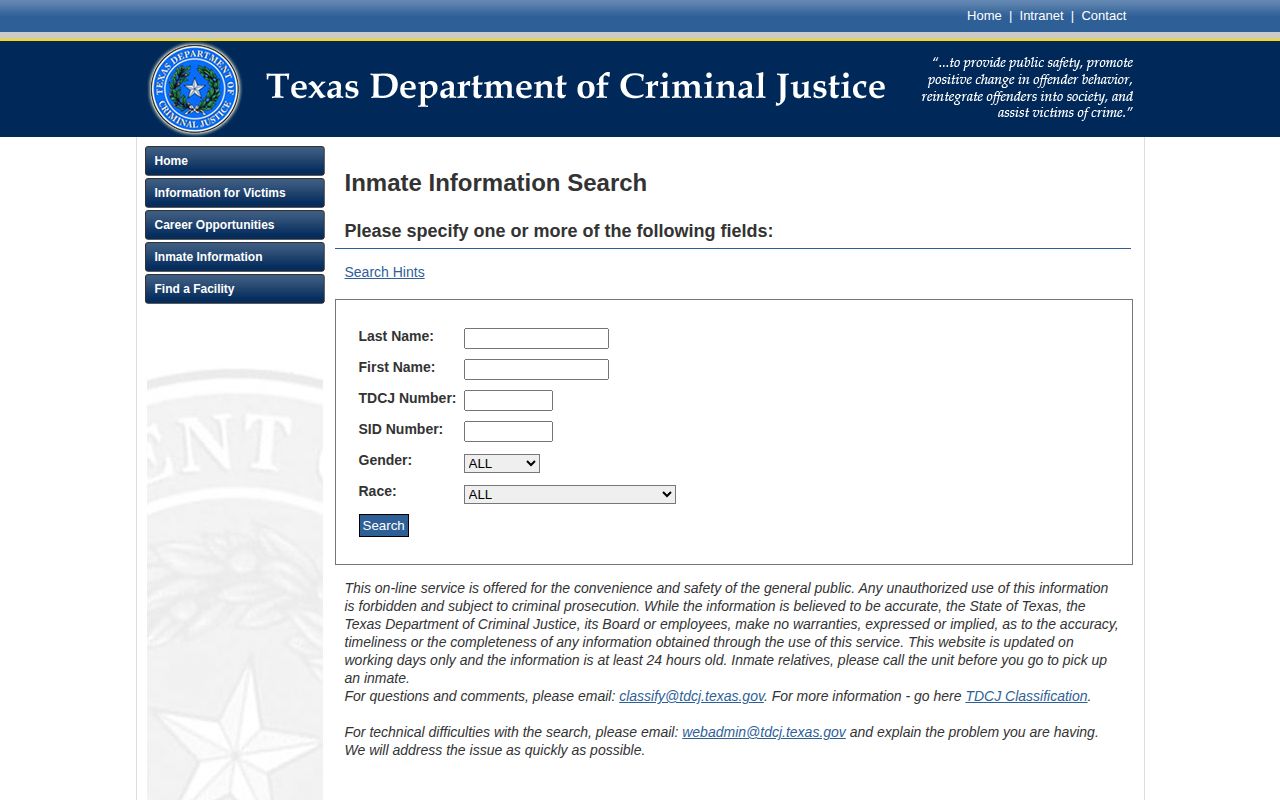
The form supports a state lookup. It does not compute a Duval County Jail sentence.
Why Duval Release Dates Change
A projected date is a snapshot of the facts and law recorded at that time. The offense date selects the statutory regime. Sentence amendments, jail credit, concurrent or consecutive cases, classification, forfeiture or restoration of good time, newly received commitment data, and corrected records can alter the calculation.
Release authority matters too. The Board can deny discretionary mandatory supervision, approve later, impose a required program, or change an earlier outcome based on new information. Detainers and holds can affect where a person goes even when one sentence permits release. A scheduled date can move while Classification and Records audits the file and prepares a certificate.
| Change | Possible effect |
|---|---|
| Corrected jail credit | Changes time credited toward the sentence. |
| Good-time forfeiture or restoration | Changes qualifying eligibility calculations. |
| Board decision | May deny, approve, defer, or impose a program condition. |
| New judgment or sentence data | Can revise the controlling calculation. |
| Detainer or hold | Can lead to continued custody or transfer elsewhere. |
| Records audit | Can change the operational scheduled date or location. |
Do not use a homemade calculator for a named person. It cannot reliably account for the full judgment, offense-date law, custody credit, classification, Board action, and holds.
Texas Good Time and Duval Dates
Texas Government Code Chapter 498 governs TDCJ classification and good-conduct time. Section 498.003 says good time applies to parole or mandatory-supervision eligibility and otherwise does not affect the sentence term. Accrual depends on classification and qualifying activity. Class III does not accrue it, and disciplinary forfeiture can change credits under Section 498.004.
Good time is not a simple subtraction from the maximum sentence. Nor does Texas use a general 85-percent rule. That shorthand is often drawn from federal practice and should not be imported into a Texas state calculation. Government Code Chapter 508 contains offense-specific parole and mandatory-supervision rules.
Section 508.145(d) uses an actual-calendar-time threshold of one-half or 30 years, whichever is less, for listed serious offenses, subject to its details. Residual subsection (f) generally uses actual time plus good time equal to one-fourth or 15 years, whichever is less. Other subsections, exclusions in Section 508.149, and offense-date law can control. Each threshold concerns eligibility, not guaranteed release.
- Good time
- TDCJ credit used for qualifying eligibility calculations, not cancellation of the sentence.
- Eligibility
- The point when a release authority may consider a qualifying case.
- Detainer
- An agency notice or request that can affect custody or destination.
- Concurrent sentences
- Terms ordered to run at the same time, subject to the judgment.
- Consecutive sentences
- Terms ordered to run one after another.
Duval County Jail Date Records
TDCJ's public projected date is not a county-jail calculation. For a local sentence, the sheriff executes the court judgment, uses certified jail credit, applies governing county-jail provisions, and accounts for other holds. Code of Criminal Procedure Chapter 42 contains county-jail sentence and work-release credit provisions.
Duval County has not published a local good-time policy, weekend-release rule, or public time calculator in the reviewed sources. Request the judgment and sheriff time sheet rather than estimating. Ask staff to identify the credit entered, release basis, timestamp, destination, and any publicly releasable hold. If the person is pretrial, ask about bond and court orders rather than demanding a projected sentence date that may not exist.
A court docket shows filings and settings. It does not establish when jail staff carried out an order. Match the clerk's signed record with the sheriff's operational entry. If the county transfers the person to TDCJ or another agency, the next custodian controls the later date.
Note: A county release date and a TDCJ projected release date come from different records and rules.
Duval Release Dates Can Reverse
Texas projected release can move to the maximum expiration date when the Board denies discretionary mandatory supervision. A later approval can move the projection earlier again. That does not make either screenshot false. Each reflects the decision and calculation in force when captured.
Even a scheduled release can change without notice, including on release day, while records, holds, and certificates are resolved. The TDCJ Ombudsman parole FAQ says Classification and Records audits and calculates the scheduled release after a certificate is issued, often taking 14 to 21 business days. The same source warns that the scheduled date can change.
Preserve a date-stamped copy of every displayed field. Record the TDCJ number, status, unit, vote code, scheduled location, and the time checked. Then follow up for actual release. A past screenshot is evidence of what the system showed, not proof of present custody.
Correct Duval Release Date Errors
Start with the office that created the disputed field. For a state time or release calculation, TDCJ routes Classification and Records questions to (936) 437-6231 and classify@tdcj.texas.gov. Formal TDCJ records requests can go to PIA@tdcj.texas.gov. Provide the TDCJ number, the exact field, the date observed, and the judgment or credit document that supports the concern.
For county-jail time, obtain the signed judgment and certified credit from the clerk, then ask the sheriff about its operational time record. If the court record itself is wrong, use the court process appropriate to that record. Keep copies of each response and do not overwrite earlier screenshots.
After a correction, rerun the official search and note what changed. Then verify any Board condition, scheduled location, detainer, and actual release. A corrected projection still remains a projection until the departure event occurs.
Confirm Duval Actual Release
On or after the displayed date, check the same official record again. For TDCJ, confirm actual release and whether parole or mandatory supervision follows. Use VINELink Release Check for the current Texas county and state notification layers, while remembering that an alert still needs custodian confirmation.
For Duval County Jail, ask the sheriff for the actual release or transfer timestamp, reason, authority, and destination. A transfer is not community release. The broader Duval County released inmate search helps identify the next custodian when the person moved between systems.
The final record should answer five points: who held the person, which event occurred, when it occurred, who authorized it, and where the person went. Only then can a projected date be compared fairly with the completed outcome.