
Where Duval Jail Releases Go
The Duval County Jail is the local jail operated by the Duval County Sheriff's Department. It receives local arrestees, pretrial detainees, people serving qualifying local sentences, and people held temporarily for another agency. Community release may follow cash, surety, or personal bond, a signed court order, dismissal, time served, or completion of a county sentence. Each event has a different legal basis.
Other departures continue custody. A transfer to TDCJ, another county jail, U.S. Marshals custody, ICE, a hospital, or another agency ends the Duval booking or physical stay but does not establish freedom in the community. Ask for the receiving agency, release or transfer time, booking number, and releasing authority. Then confirm intake with that agency. The sheriff entry and signed court or bond record form the strongest local proof package.
| Entry | Meaning | Verify next |
|---|---|---|
| Bond | Leaves pretrial detention under conditions | Bond and court docket |
| Time served | Confinement credited or completed | Judgment and release entry |
| Transfer | Another custodian accepted the person | Receiving agency intake |
| Court order | Judge authorized the change | Signed order |
Confirm Duval County Jail Release
No official online jail roster or recent-release view was verified on the sheriff's website. There is no published update cadence, archive duration, release-hour schedule, photo gallery, or mobile app. Call dispatch at (361) 279-3351 for immediate status. Ask whether the person is held now and, if not, request the last release date, time, type, destination, and booking number.
- Confirm Duval County, Texas, using the San Diego address and 361 area code.
- Give the exact name, date of birth, and approximate arrest date.
- Ask whether the event was community release or transfer.
- Check the county or district court file for the signed authority.
- Request the existing booking and release record in writing.
The full Duval County released inmate search explains state, court, notification, federal, and immigration checks when the local answer points elsewhere.
Duval Jail Records and Contact
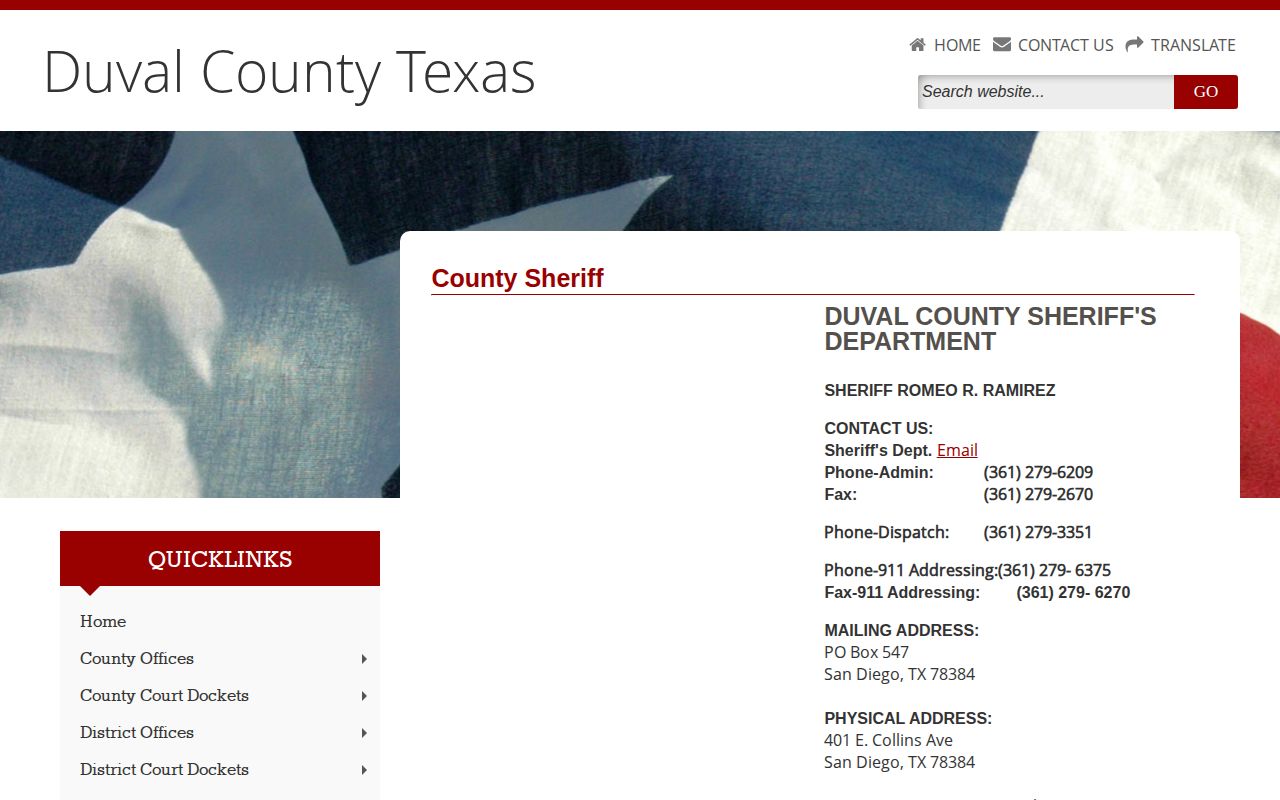
The official sheriff page lists the jail and department at 401 E. Collins Ave., San Diego, TX 78384, with mailing address PO Box 547. Administration is (361) 279-6209, dispatch is (361) 279-3351, and fax is (361) 279-2670. Administrative hours are Monday through Friday, 8 a.m. to noon and 1 to 5 p.m. Dispatch is the published round-the-clock contact for immediate status.
The official source image shows the Duval County Jail release contact route and the lack of a linked live release feed.
View the Duval County Sheriff's Department source.
Use the written records route when proof matters, since a phone status check does not supply the underlying event record.
Request Duval Jail Release Records
Texas Government Code Chapter 552 governs access to government records. The sheriff publishes no special jail-release request form, fee schedule, or promised response time. Ask for existing records in a focused date range and request electronic copies in their native format. The law does not require staff to create a new report, calculate a sentence, or answer why a person was released.
Request the booked name and aliases, booking number, arrest date and agency, charges and cause numbers, bond fields, housing or admission date, release date and time, release reason, releasing authority, transfer destination, releasable holds, correction notations, and booking photograph. Not every field must be public. Juvenile, medical, security-sensitive, confidential, or active-investigation material may be withheld or redacted.
If staff say no document is called a “release record,” ask for the jail card, booking sheet, release screen or entry, custody log, transfer sheet, bond-release record, and photograph. Ask for an itemized estimate before chargeable work. If an exception is asserted, preserve the written response and any Attorney General ruling reference.
Duval Jail and Court Records
Court records explain the authority behind a custody change. Use the cause number to obtain the signed bond order, dismissal, judgment, sentence, jail-credit entry, revocation order, or discharge order. Duval County and District Court docket listings are useful leads, but a hearing date or “in jail” docket grouping is not proof of release.
Felony files ordinarily come from the District Clerk. Misdemeanor files ordinarily come from the County Clerk. Compare the cause and charge to the sheriff booking. A sentence end date can differ from physical release because of credit, another case, a hold, or transfer. The court record establishes legal authority; the sheriff record establishes what happened operationally.
Duval Jail Facility History
No official capacity figure, visitation detail, property-release policy, bond schedule, or release-hour schedule was found on the sheriff page. Those gaps should not be filled from commercial directories. The county's adopted budget includes an out-of-county inmate-housing line, which shows that such housing is possible but names no contract facility and proves nothing about a particular person.
A December 2025 Texas Commission on Jail Standards notice documented noncompliance found during a special inspection, including screening-instrument and staffing-related matters. It is facility-history context only. It cannot determine whether a named release was valid or where that person went.
Duval Jail Versus Glossbrenner
Duval County contains two correctional systems that are easy to confuse. The sheriff jail handles local custody. Ernestine Glossbrenner Unit is a TDCJ Substance Abuse Felony Punishment Facility with IPTC treatment. A person departing Glossbrenner may move into aftercare or supervision, return to another unit, enter county custody, or follow another detainer. That event is checked through TDCJ, not the county jail.
The 612-capacity state facility is larger than many readers expect in a rural county, but its presence does not turn every Duval arrest into a TDCJ case. Identify the last custodian before searching. For a sheriff episode, stay with the release entry and court authority. For state custody, use the statewide TDCJ record and actual release status.
Correct Duval Jail Release Records
When a release field appears wrong, identify the exact booking, disputed value, and source document that supports a correction. A signed bond, dismissal, judgment, transfer receipt, or receiving-agency intake record is more useful than a general claim. Send copies through the sheriff records channel and keep the original response. If the destination is missing, ask for the existing transfer sheet, custody log, or release screen rather than requesting a new explanation.
Expunction and nondisclosure have different effects. Texas Code of Criminal Procedure Chapter 55A governs expunction. Government Code Chapter 411 governs nondisclosure. Neither follows from release alone, and dismissal does not automatically erase the arrest or booking. Duval's District Clerk publishes an expunction-order recipient list that includes local clerks, the District Attorney, sheriff, probation, and state agencies, while warning that its list may not be complete.
Current Chapter 55A requires an expunction-law notice at qualifying release or discharge after arrest. The notice explains the statute, but it does not prove eligibility. A final order controls covered records and routing. For a record that remains public, seek correction from the office that created the disputed field. For a court disposition, obtain the clerk's signed record. For an operational release time or destination, use the sheriff record.
Duval Jail Status Across Systems
If the sheriff reports TDCJ transfer, allow for intake lag and search by TDCJ or SID number. If the entry names federal custody, BOP covers sentenced federal prisoners while U.S. Marshals records and the federal docket address many pretrial movements. If ICE accepted the person, the Online Detainee Locator is a current-custody and limited recent-release tool, not a full historical archive. Each no-match is inconclusive until the receiving agency and identifiers have been checked.
Texas IVSS-Counties replaced the former county VINE path in 2025. Use it only if the live portal confirms Duval participation. A release alert reports the source agency's event. It cannot rule out another booking, a detainer, or a transfer to a different sovereign. The sheriff's release reason and destination remain central.