
Duval County Three-Day Release Source
The Duval County Sheriff's Department publishes its address, dispatch number, and administrative number. It does not link a rolling 72-hour release view, jail roster, or release archive. Targeted searches of the official county domain found no separate three-day endpoint. That means there is no verified public display cadence, retention span, release-time field, or photograph field to describe.
The absence of an online feed is a local finding. It must not be filled with a commercial list or a Jacksonville, Florida result. A Texas source should connect to San Diego, the 361 area code, `co.duval.tx.us`, or the correct state system. A three-day response should come from the existing jail-management record, not an unsourced compilation.
The official sheriff page shown below is the local contact route and demonstrates that no release feed is linked there. Review the current source when checking because county services can change.
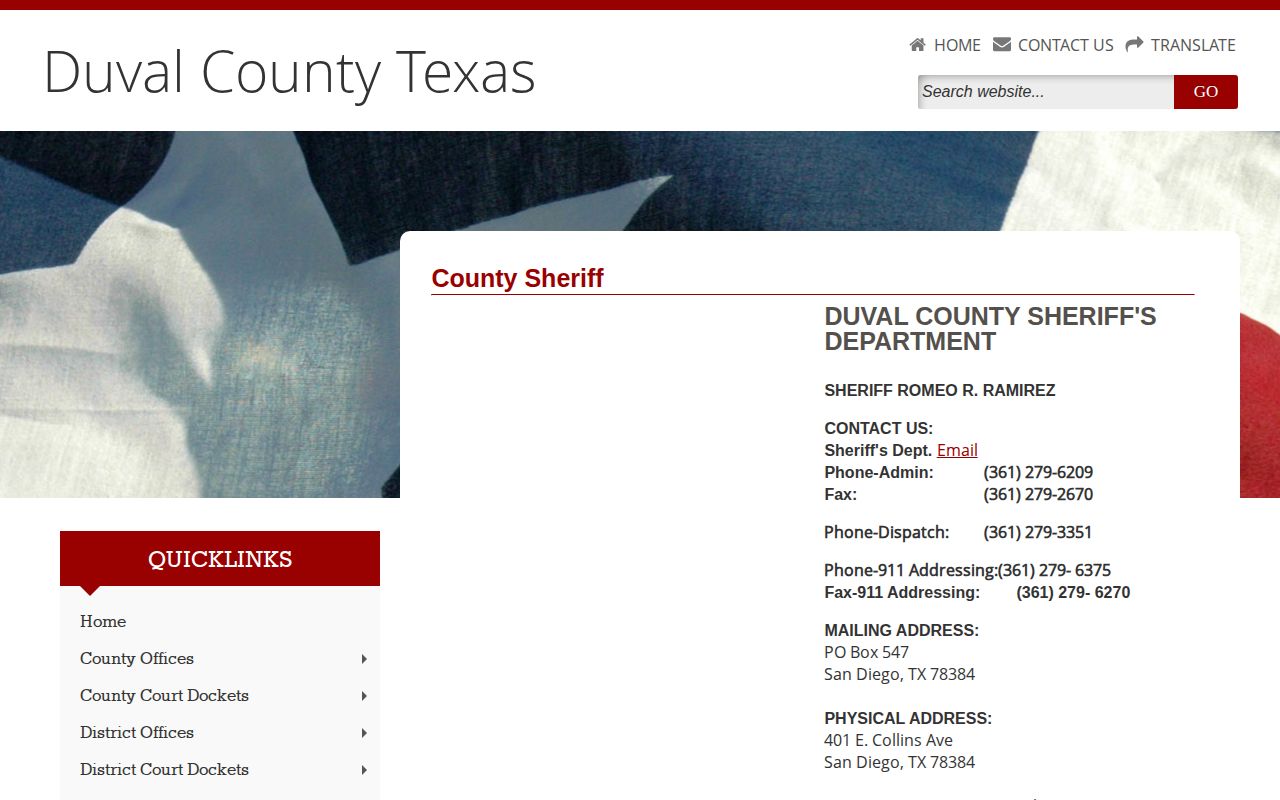
The page supports a records-based request, not a claim that a live three-day list exists.
Check Duval County 72-Hour Releases
A precise request reduces ambiguity at both ends of the interval. “The last three days” can shift during processing. Use actual dates and times, identify Central Time, and request existing electronic entries. The Texas Public Information Act does not make an agency create a new report or answer a research question.
- Write the exact start and end timestamps. Include the year and time zone.
- Ask sheriff administration at (361) 279-6209 during posted office hours for the existing release log or jail-management entries within that range.
- Request the booked name, booking number, release date and time, reason, releasing authority, and destination or accepting agency.
- Ask whether the data includes transfers, and whether delayed entries or corrections fall outside the report run.
- For a current urgent check, call dispatch at (361) 279-3351 and provide a full name plus birth detail or booking date when known.
- Match each event to the County Court docket or District Court docket, then obtain the signed order or disposition.
Duval publishes no special sheriff fee schedule or guaranteed turnaround for this record. Ask for a cost estimate if charges may apply. Request the native electronic format when it already exists because it can preserve event labels and sortable times. For only today's events, use Released Last 24 Hours.
Duval County Three-Day Fields
No public Duval feed was available to inspect, so these are requested fields, not promised display columns. Some information can be withheld or redacted. The goal is to identify one booking episode and the event that ended or moved it.
| Field to request | Use in a 72-hour check |
|---|---|
| Booked name and aliases | Reduces confusion from spelling variants. |
| Booking number | Separates repeat bookings and similar names. |
| Release timestamp | Places the event inside the defined three-day range. |
| Release reason | Distinguishes bond, time served, dismissal, sentence completion, or another event. |
| Releasing authority | Connects the operational event to a court or agency action. |
| Destination or accepting agency | Separates community release from continued custody. |
| Correction notation | Shows whether staff later amended an event field. |
A detainer is an agency notice or request concerning custody. A detainer or transfer destination can explain why a person left Duval County Jail but did not enter the community. The receiving custodian should confirm the next stage.
Duval Weekend Release Window
A 72-hour span is useful when an event occurred late Friday, during a weekend, or near a holiday. Administrative records staff publish weekday office hours, while dispatch is the round-the-clock immediate-status contact. That difference can delay access to the durable written record even when the operational event has already occurred. It does not change the release timestamp itself.
Choose a range that covers the full period of concern. A Monday request for “the weekend” should specify Friday's start time through Monday's end time rather than rely on an undefined phrase. If the office was closed, ask whether late entries, quality review, or a later report run could affect the response. No Duval source publishes a standard lag, so do not invent one.
Court dockets provide a durable follow-up, but docket labels are time-specific. Duval's County Court archive has used an “In Jail Supplement,” and a District Court docket has separated jail and non-jail cases. Those headings do not certify release. Obtain the signed bond order, judgment, dismissal, or other disposition, then compare it with the sheriff event.
Note: A three-day range catches more events, but it does not turn a docket setting into proof that someone left custody.
Duval Release Verification Chain
Start with the agency that held the person. For Duval County Jail, that is the sheriff. Texas IVSS-Counties can provide event and notification data when the live portal shows Duval participation. Texas replaced the former county VINE channel in 2025. A portal match should still be confirmed with the source agency, while no match remains inconclusive.
If the county entry identifies a TDCJ transfer, search the TDCJ offender system and use the separate TDCJ IVSS. TDCJ projected or scheduled dates are not actual release proof. A federal transfer calls for the proper federal custodian, while an ICE acceptance is checked through immigration custody channels. Each system answers a different question.
| Event | Follow-up source |
|---|---|
| Community bond or time-served release | Sheriff release entry plus signed court record |
| TDCJ transfer | Sheriff destination plus TDCJ intake/status |
| Other county transfer | Duval event plus receiving jail |
| Federal or immigration acceptance | Duval transfer entry plus the named federal custodian |
The Duval County released inmate search gives the full named-person path when the custodian is not known. It is broader than a three-day interval report.
No Duval Release Archive
The official-domain sweep found no Duval roster or recent-release archive. As a result, no honest claim can be made about how long names remain visible, when a list refreshes, whether photographs appear, or whether release reason is shown. Those facts are unknown because the display does not exist in the reviewed official sources.
A bounded records request is more durable. Ask for existing fields, state whether transfers are wanted, and retain the agency response. If a later correction arrives, preserve both versions and the date of the change. For one named booking, request the jail card or jail-management record and match it to the court cause number. That evidence chain survives after a hypothetical rolling window would have expired.
- Community release
- Departure from custody into the community under the stated legal basis.
- Transfer
- Movement to another custodian rather than freedom from custody.
- Discharge
- Completion of the sentence or supervision shown by the controlling record.
- Release log
- An existing operational record of events, subject to the fields the sheriff actually maintains.
Preserve Duval Three-Day Results
Save the exact interval, request wording, response date, and record identifiers. A name alone is weak proof. Link the booking number to the release event and the court cause number to the authorizing action. When a portal notification is used, note its reporting agency and event timestamp.
Conflicting dates need source-specific review. Ask the sheriff about the operational departure record, the clerk about a filed order, and TDCJ about a state time calculation. Do not merge unrelated records to make a clean timeline. A three-day search is complete only when the custodian, event, authority, time, and destination align.
Repeat bookings can fall inside one 72-hour span. Keep each booking number separate, even when the name and date of birth match. One entry may show release on bond while another reflects a later arrest or agency transfer. A later event does not erase the earlier event, but it changes any claim about present status. Request all matching booking identifiers within the interval and read them in time order.
Also distinguish the date a court filed an order from the date jail staff carried it out. Both can be valid, yet they answer different questions. The clerk's file explains legal authority. The sheriff record supplies the operational release or transfer time. If another agency accepted custody, that agency supplies the next status.
For a person expected home after the three-day period, direct confirmation matters more than an old event. A prior community release can be followed by a new booking, and a transfer record can be followed by later release from the receiving system. Recheck the current custodian rather than extending the old status beyond its timestamp.