
Duval Immigration Custody Transfers
Duval County Jail may record that a person left on bond, time served, court order, sentence completion, or transfer. An ICE detainer changes the meaning of the last option. A detainer is a request or hold tied to another authority’s custody interest. When ICE accepts the person, the county stay ends while custody continues under a different legal system. Ask for the receiving agency, transfer time, and destination when publicly releasable.
No ICE center was found within Duval County during the official facility sweep. The South Texas ICE Processing Center is in Pearsall, outside the county, and should not be named as a destination without a person-level transfer record. A detainee can also move among ICE or non-ICE contract facilities. Geographic proximity does not prove placement.
| Record | Use | Limit |
|---|---|---|
| Duval sheriff release entry | Shows end of county booking and receiving agency | Does not establish later ICE release |
| ICE ODLS result | Shows qualifying current or recent ICE custody | Not a durable historical archive |
| ERO confirmation | Helps resolve no-match or facility questions | Disclosure may be limited |
| Court record | Explains local criminal order | Not an ICE custody log |
Search Duval Immigration Custody
The official ICE Online Detainee Locator System, or ODLS, offers two search methods. One uses the A-number with country of birth. The other uses biographical details. Exact spelling and the correct country matter. ODLS covers qualifying people now in ICE custody or released from ICE custody within the last 60 days. Some recent bookings and people under 18 may not appear.
Use a focused sequence and keep the county release record nearby.
- Confirm Duval County, Texas, the local booking, and the full booked name.
- Request the sheriff’s release type, receiving agency, transfer time, and destination.
- Search ODLS by A-number and country of birth when those details are lawfully known.
- Try the offered biographical search with exact name and birth details.
- Read any custody or release label by its date and reporting agency.
- If no result appears, contact the correct ICE ERO field office and treat the search as unresolved.
A no-match can reflect release, transfer, an input mismatch, a recent record not yet visible, age limits, or a record beyond the public window. It is not proof of community release. A match also requires care because names can repeat.
Duval ICE Release Meaning
An ODLS release result concerns ICE custody. It does not by itself resolve a Duval criminal case, a state warrant, federal custody, or current location. Pair it with the county record that explains how local custody ended. When a court case was pending, obtain the signed bond, dismissal, sentence, or other order from the Duval clerk. A docket setting is not the same as a custody event.
The word “release” can sit at several points in one timeline:
Arrest → Duval County booking → county transfer to ICE → ICE detention → ICE release or another transfer.
Each arrow can have its own date and custodian. A family member may hear that someone was “released by Duval” while the person remains detained elsewhere. Ask which agency had custody before and after the event. That one question prevents the most common error.
- A-number
- An immigration identifier used with country of birth in the ICE locator.
- Detainer
- A request that may result in another authority accepting custody.
- ERO
- ICE Enforcement and Removal Operations, the office network handling detention and field questions.
- Transfer
- Movement between custodians, not freedom in the community.
Duval Immigration Release Proof
The Duval County Sheriff’s Department holds the local booking and release entry. Its official page lists administration at (361) 279-6209 and round-the-clock dispatch at (361) 279-3351. For fast status, ask whether the person remains held. For documentation, request the booking number, release date and time, release type, receiving agency, destination when releasable, and public detainer fields.
The office is at 401 E. Collins Ave., San Diego, TX 78384, with mail to PO Box 547. Posted administrative hours are Monday through Friday, 8 a.m. to noon and 1 to 5 p.m. No dedicated online jail request form, fee table, or promised turnaround was verified. Ask for existing electronic records and a cost estimate before chargeable work.
Duval County Sheriff’s Department
401 E. Collins Ave.
San Diego, TX 78384
Administration: (361) 279-6209
Dispatch: (361) 279-3351
Hours: Monday to Friday, 8 a.m. to noon and 1 to 5 p.m.
If the entry identifies ICE, move to ODLS and ERO. If it identifies USMS, use the federal court and Marshals route. If it identifies TDCJ, use the state offender search. The receiving agency controls the next custody record.
ICE Field Office Contacts
ICE’s official field-office directory is the fallback when ODLS does not resolve a supported immigration-custody question. Choose the office based on the actual case or detention location, not merely the Duval arrest. Have the A-number, full name, country of birth, birth date, and known transfer details ready. Disclosure can be limited, and the office may require identity or authorization checks.
The image below comes from the same official ERO directory. It shows the agency contact route that applies when the locator has no usable result.
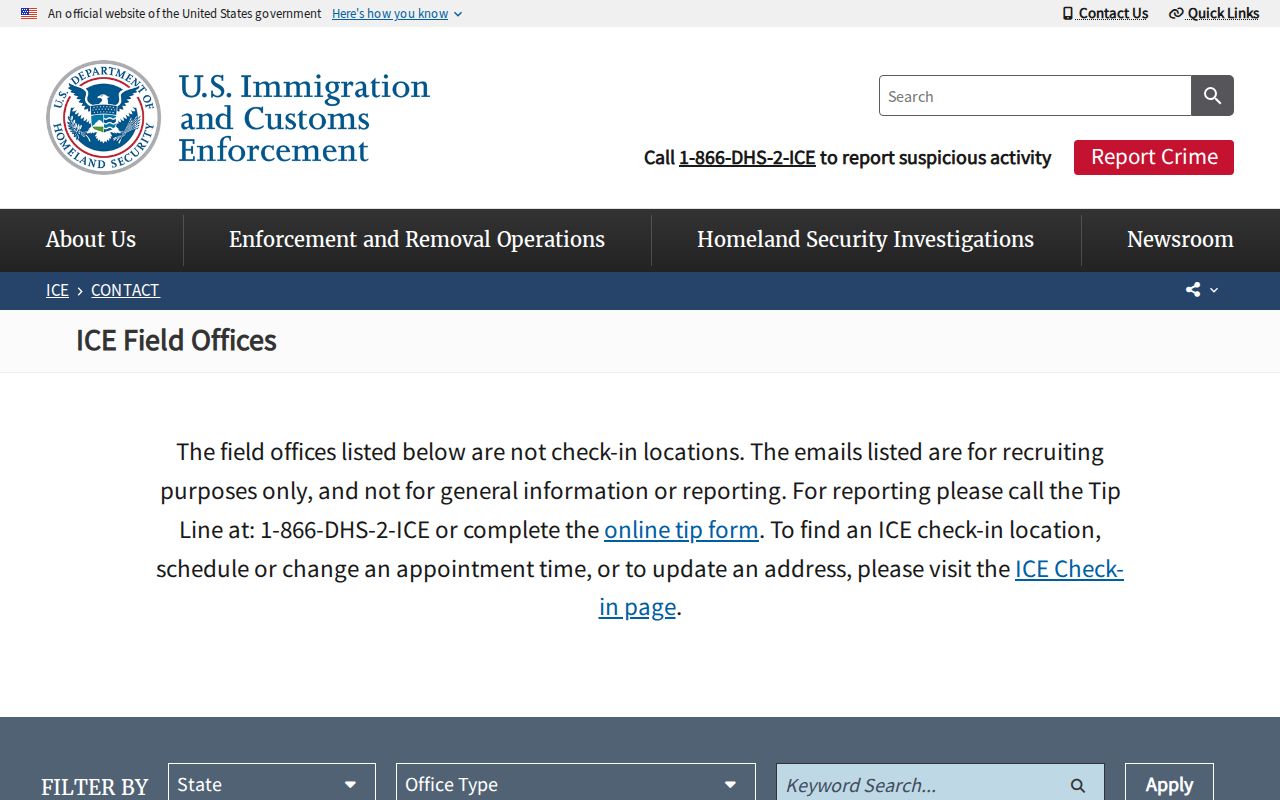
The directory helps locate the responsible office. It does not prove that a person entered or left any listed facility.
Duval County Court Records
Immigration custody and the local criminal case are separate. Duval County and District Court dockets may identify the criminal cause, while signed orders establish bond, dismissal, sentence, or another result. Felony files are ordinarily obtained from the District Clerk. Misdemeanor files generally come from the County Clerk. The court record can explain why county confinement ended but may not show where ICE later moved the person.
Use the cause number to request the docket sheet and signed papers. Compare the defendant name, charge, arrest date, booking number, and court order with the sheriff entry. A sheriff “release to ICE” should be read as a transfer. A later ICE release requires its own evidence. This record-by-record method also catches a later state or federal hold.
The Duval County released inmate search path covers the local booking and court-record request in full. Keep no more personal data than needed to distinguish the correct person.
Confirm Duval ICE Release
A strong file starts with the Duval sheriff’s transfer entry, then adds the matching ODLS result or ERO confirmation. Include the court order when the local criminal case explains the county exit. Record when each source was checked. The ICE locator’s public window means an older release may require direct agency or legal-record follow-up.
Do not substitute a county roster search for an immigration custody check. Released people generally disappear from a current-custody list. Likewise, do not use BOP for civil immigration detention or TDCJ for an ICE transfer. Each system has its own scope.
Note: A person absent from both the Duval jail and ODLS may still require agency confirmation because transfers and data delays can create gaps.
Duval ICE Record Requests
A written request should name the exact event held by the recipient. Ask the sheriff for the local booking, release entry, receiving agency, and publicly releasable detainer fields. Ask ICE for its own custody or release record through the federal process that applies. One agency is not required to create the other agency’s document. Separate requests also make conflicting dates easier to identify.
Keep the source response with the search result. ODLS is a changing interface, so save the check date, search mode, exact spelling, and displayed agency or facility. If the result reports a recent release, seek the event record before treating the label as complete. The event does not establish dismissal of the Duval criminal charge or freedom from all other holds.
Some information may be restricted for privacy, safety, or legal reasons. Request the public portion and follow the agency’s identity or authorization rules. A focused date range and correct A-number can reduce delay. Never infer a destination from a regional facility name that appears in unrelated search results.
Duval ICE Search Identity
Names may be entered in more than one form, and birth or country details can separate similar results. Use the spelling from an official Duval or immigration record. If the A-number is not known, do not guess it. Ask the proper agency or authorized representative for the correct identifier, then repeat the search and document the date.