
Where Texas Corrections Releases Go
TDCJ operates and contracts for prisons, state jails, treatment units, and pre-release locations across Texas. A conviction from Duval County can lead to confinement anywhere in that network. The county of conviction is useful for matching an offense row, but it does not identify the person's current unit or final release site.
Departure may be parole, mandatory supervision, maximum-expiration discharge, transfer to another unit, a treatment or intermediate placement, county custody, or another detainer. Release from prison can still leave the person under TDCJ legal custody through parole or mandatory supervision. Discharge is different because it marks completion of the sentence and listed supervision.
| Status | What it means | Next source |
|---|---|---|
| Projected release | Conditional time calculation | TDCJ definitions and record |
| Parole eligible | May be considered | Board status |
| Scheduled release | Operational date and place after processing | Release-status line |
| Released | Left incarceration, perhaps to supervision | Parole office or certificate |
| Discharged | Sentence and supervision completed | TDCJ discharge record |
Search TDCJ Duval Release Records
The official TDCJ offender search advertises location, offenses, and projected release date. Search with the TDCJ number when available because names can collide. SID number is another strong identifier. Otherwise use exact name and available biographical fields, then match the Duval County conviction and offense details.
- Enter the TDCJ or SID number, or the exact name fields.
- Open the matching detail record.
- Compare identity, county, court, offense, and sentence rows.
- Read projected, eligibility, maximum, and scheduled dates by their exact labels.
- Save the date checked because projections and status can change.
- Confirm actual release or discharge after the listed date.
If a former state record does not appear, use TDCJ's official email or phone path. A no-match does not erase state history.
Texas Corrections Search Fields
Public detail pages vary by status and data availability. Common fields include name, TDCJ number, SID number, race, gender, projected release date, parole eligibility date, maximum sentence date, current facility, and offense rows. Each answers a narrow question.
| Field | Use |
|---|---|
| TDCJ number | State-system identity |
| SID number | Cross-system identity match |
| Current facility | State placement when shown |
| Projected date | Conditional incarceration projection |
| Eligibility date | Earliest consideration under the shown calculation |
| Maximum date | Term endpoint under the current record |
| Offense rows | Conviction county, court, offense, and sentence |
The official unit directory image below helps distinguish statewide TDCJ custody from the local sheriff jail.
Open the TDCJ statewide unit directory.
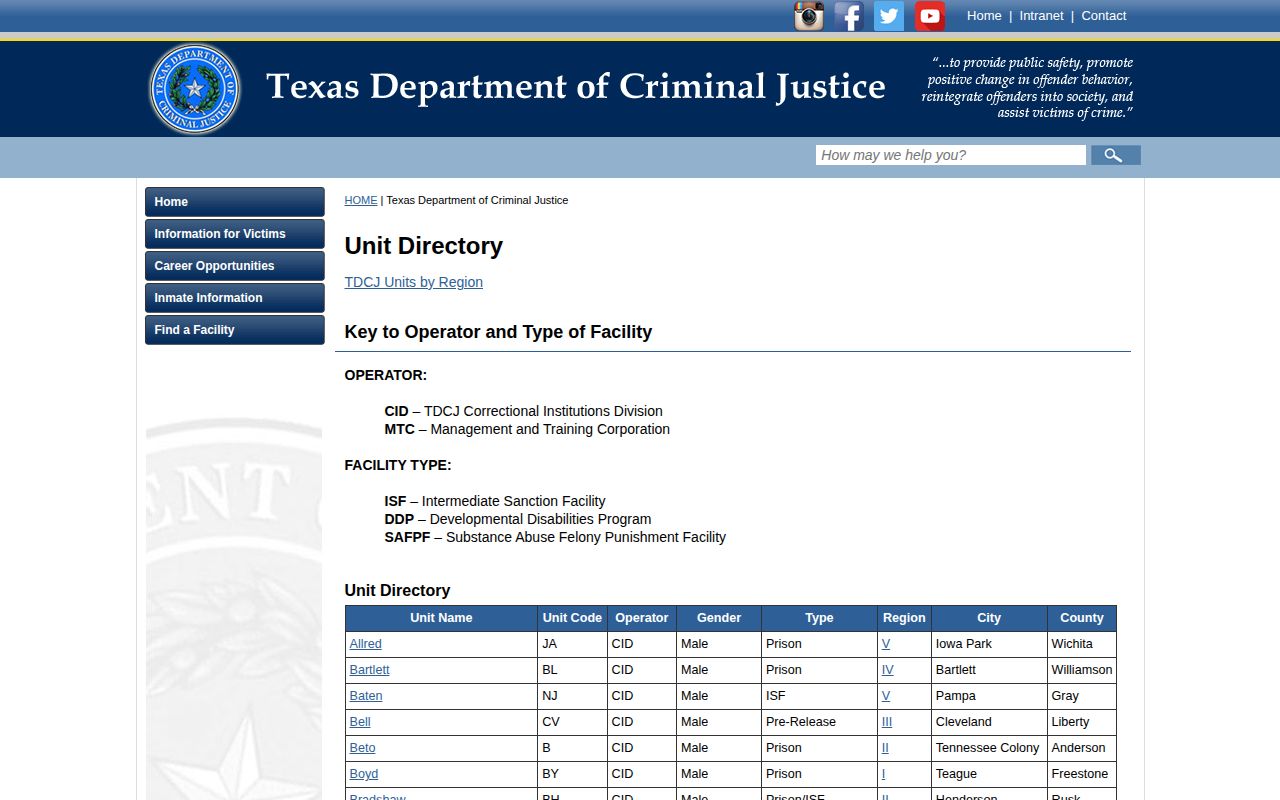
Use the named unit's official page only after the state record establishes the placement.
TDCJ Records and Contact
General inmate-location information is available at (936) 295-6371 or (800) 535-0283 during weekday business hours. TDCJ also permits a free email to pia@tdcj.texas.gov for ordinary status information. Provide full name and seven-digit TDCJ number. Without the number, give exact birth date or approximate age and county of conviction.
That channel can return TDCJ number, location, conviction or offense information, county and court, and projected release date. TDCJ expressly says photographs and Social Security numbers are not supplied by the general email route. For pre-vote parole review, use (844) 512-0461. For post-approval release status, use (512) 406-5202.
Formal public-information requests can go to PIA@tdcj.texas.gov or TDCJ Public Information Request, PO Box 4017, Huntsville, TX 77342. Ask for the release certificate, actual release or discharge date and type, release location, public commitment and calculation fields, and public portions of the supervision record. Government Code section 508.313 protects specified parole information, so no complete internal Board file should be promised.
Texas Release Dates Can Change
TDCJ defines projected release as the Classification and Records Office's projection if parole does not occur sooner, affected by offense title and date. Parole eligibility means the person may be considered. It does not mean approval. Maximum sentence date is another calculation, while scheduled release date and location appear only after the process reaches an operational stage.
The Ombudsman FAQ says Classification and Records audits and calculates the scheduled release after a certificate issues, often taking 14 to 21 business days. It also warns that the scheduled date can change without notice, including on release day. Detainers, required programs, discipline, new commitment information, and certificate processing may alter the result.
Keep a date-stamped copy of the displayed fields, then confirm the actual event. If a calculation conflicts with the judgment or credit record, contact Classification and Records at (936) 437-6231 or classify@tdcj.texas.gov and identify the exact field.
Texas Good Time and Release
Texas does not impose a universal rule that every prisoner serves 85 percent. Government Code section 498.003 says good-conduct time affects parole or mandatory-supervision eligibility where allowed and otherwise does not reduce the judicial term. It is a privilege, not a right. Classification controls accrual, and section 498.004 governs forfeiture and possible restoration.
Government Code section 508.145 contains different eligibility rules based on offense, date, and sentence. For listed serious offenses, subsection (d) generally uses actual calendar time equal to one-half of the sentence or 30 years, whichever is less, without good time toward that threshold, subject to its details. Residual cases can follow other rules. Eligibility still does not guarantee release.
A Duval County jail sentence does not use the TDCJ public projected-date calculation. For local custody, obtain the judgment, jail credit, time sheet, holds, and sheriff release record instead of trying to calculate the date from state-prison fields.
TDCJ Parole After Duval Release
The Board of Pardons and Paroles makes parole and revocation decisions. TDCJ Parole Division supervises people released on parole or mandatory supervision. Board review, approval, physical prison release, and sentence discharge are different events. A decision code or target date should be checked against the actual state status.
Duval County is assigned to the Laredo District Parole Office at 6020 McPherson Road, Suite 6, Laredo, TX 78041, phone (956) 724-1933. Do not assume that office from geography alone for a particular person, since approved residence and caseload assignment can differ. Use the TDCJ directory and individual record.
TDCJ IVSS provides a separate notification layer for state prison, parole, mandatory supervision, Board decisions, release, and discharge. It is distinct from IVSS-Counties, the system used for participating county jail events.
Texas Units Serving Duval Cases
The statewide TDCJ unit directory is the source for the current unit's address and contact details. It should not be used to guess where a Duval County defendant was sent. First confirm placement through the offender record or inmate-information staff.
Glossbrenner is the named TDCJ unit within Duval County, but it is not the only state path for a Duval conviction. Its SAFPF and IPTC treatment programs can lead to aftercare, supervision, another state placement, or a detainer outcome. Other people may serve their sentences anywhere in the statewide network and leave through regional release sites.
The Duval County release search compares sheriff, state, federal, and immigration records. Follow the custodian shown by the evidence instead of treating all missing jail names as state releases.
Correct Texas Release Records
A wrong TDCJ date or status should be challenged field by field. Preserve a dated search result, then collect the judgment, sentence, jail-credit certification, Board decision, release certificate, and any later court order that bears on the calculation. Classification and Records is the subject office for time and release fields. A formal Public Information Act request can obtain the releasable underlying record.
Do not ask TDCJ to create a new calculation or decide a legal dispute through a routine locator call. State the exact record and date range sought. If another custodian accepted the person, obtain that agency's intake record too. The combination distinguishes a TDCJ release, transfer, supervision transition, and full discharge.