
Duval County Release Records
“Released” describes the end of one custody event. It does not always mean the person entered the community. The Duval County Sheriff's Department may record bond, time served, dismissal, a court order, sentence completion, or transfer. A transfer to TDCJ, another jail, a federal authority, ICE, a hospital, or another agency ends the local stay but continues custody elsewhere. The useful question is which authority accepted the person next.
County jail records tie the event to a booking number, date, reason, releasing authority, and destination. TDCJ uses different terms for release from prison, parole, mandatory supervision, and discharge. Discharge means the sentence and any listed supervision have ended. Parole is conditional release from prison, while probation, called community supervision in Texas, is imposed by a court and managed locally. Those labels determine the next place to check.
- Time served
- The confinement credited or ordered in the judgment has been completed.
- Detainer
- A request from another authority to take custody when local release would otherwise occur.
- Discharge
- Completion of incarceration and supervision under the sentence.
How Duval County Releases Occur
A bond release normally leaves the criminal case pending. Time served satisfies the confinement portion shown in the judgment, though another cause or supervision may remain. A signed dismissal ends that prosecution but does not clear a separate hold. Parole and mandatory supervision move a state prisoner into supervised release. A transfer changes custodians and must never be read as proof the person is free.
| Release entry | Meaning | Next check |
|---|---|---|
| Bond or personal bond | Leaves pretrial detention under conditions | Signed bond and court docket |
| Time served | Local confinement credited or completed | Judgment and sheriff entry |
| Parole | Conditional prison release | TDCJ and Parole Division |
| Transfer | Another authority accepted custody | Receiving agency record |
| Discharge | Sentence and supervision completed | TDCJ or court discharge record |
A person may also leave a roster because of a spelling mismatch, delayed data, a sealed record, or death. The missing name alone proves none of these events.
What Duval Release Records Show
Ask for the booking and release record for one named person and booking episode. The sheriff has not published a field dictionary, so describe the existing fields sought. Some information may be withheld or redacted, including juvenile, medical, security-sensitive, confidential, or active-investigation material.
| Field | What it can establish |
|---|---|
| Booked name and aliases | Identity used for the episode |
| Booking number and time | The specific jail stay |
| Charges and cause numbers | Links to court files |
| Release date and time | When Duval custody ended |
| Reason and authority | Bond, order, sentence, or other basis |
| Destination | Community or receiving custodian |
| Holds | Releasable detainer information |
The strongest proof combines the sheriff event with the signed bond, judgment, dismissal, or other court order. If another agency accepted custody, obtain its intake record too.
Request Duval County Release Records
The Duval County Sheriff's Department lists no dedicated online jail-record form, fee table, or promised turnaround. A written Texas Public Information Act request should seek existing records, not ask staff to create a report or explain why a release occurred.
- Give the full name, date of birth, and a narrow booking-date range.
- Ask for the jail card, booking sheet, release entry, transfer sheet, and booking photograph.
- Specify release date, time, reason, authority, destination, and releasable holds.
- Request electronic copies in their existing format and an estimate before chargeable work.
- If material is withheld, ask for the public remainder and legal basis.
Records contact:
Duval County Sheriff's Department
401 E. Collins Ave., San Diego, TX 78384
PO Box 547
Administration: (361) 279-6209
Fax: (361) 279-2670
Monday through Friday, 8 a.m. to noon and 1 to 5 p.m.
The county does not publish how long a released booking stays visible because no official roster was verified. Website display and government retention are separate. A removed public display does not prove the underlying record was destroyed.
Duval Release Law and Expunction
Texas Government Code Chapter 552 governs requests for government records and includes both access rules and exceptions. A clear written request fixes its scope and timing. The agency may seek clarification, assess allowed charges, redact protected fields, or request an Attorney General decision. Ask for segregable public portions rather than assuming one protected field blocks the whole record.
Expunction under Code of Criminal Procedure Chapter 55A differs from nondisclosure under Government Code Chapter 411. Expunction can require covered agencies to destroy or return records. Nondisclosure limits public disclosure but does not erase every government file. Neither follows automatically from release or dismissal.
Duval Expunction Release Notices
The Duval District Clerk posts an SB 1667 recipient list for expunction orders. It names local clerks, the District Attorney, sheriff, probation, and state agencies, while warning that the list may not be complete. Current Chapter 55A also requires an expunction-law notice at a qualifying release or discharge after arrest. That notice explains the law. It does not establish eligibility or prove the date and type of release. Use the District Clerk's current materials and the statute for the operative process.
Find Released Duval County Inmates
Start with the custodian, not a broad name search. Confirm Duval County, Texas, because searches often return Jacksonville, Florida. Collect the exact name, date of birth, arrest date, agency, and cause number when known.
- Call sheriff dispatch at (361) 279-3351 for a local jail episode. Ask for status, release time, type, destination, and booking number.
- Check Texas IVSS-Counties only if the portal shows Duval participation. Treat no match as inconclusive.
- Inspect the county and district court dockets, then obtain the signed order from the proper clerk.
- Search TDCJ when state custody, Glossbrenner placement, parole, or mandatory supervision is possible.
- Use BOP or ICE only when the case facts show a federal or immigration path.
- Submit the focused sheriff request when documentary proof is needed.
The Released Last 24 Hours page explains the local same-day fallback. No official Duval release feed was verified.
TDCJ Search for Duval Releases
The TDCJ Online Inmate Search is the correct first search for a state prisoner or person tied to state parole. It is not the place to prove that someone merely bonded out of the Duval County Jail. Search by TDCJ or SID number when possible, then match the full name and biographical fields.
| Field | How to read it |
|---|---|
| TDCJ or SID number | Strong identity match |
| Current facility | Present state placement when shown |
| Projected release date | Conditional calculation, not a promise |
| Parole eligibility | May be considered, not approved |
| Maximum sentence date | Term endpoint under the displayed calculation |
| Offense rows | County, court, sentence, and offense detail |
The official search screen below shows the fields used to start a Texas state-custody lookup.
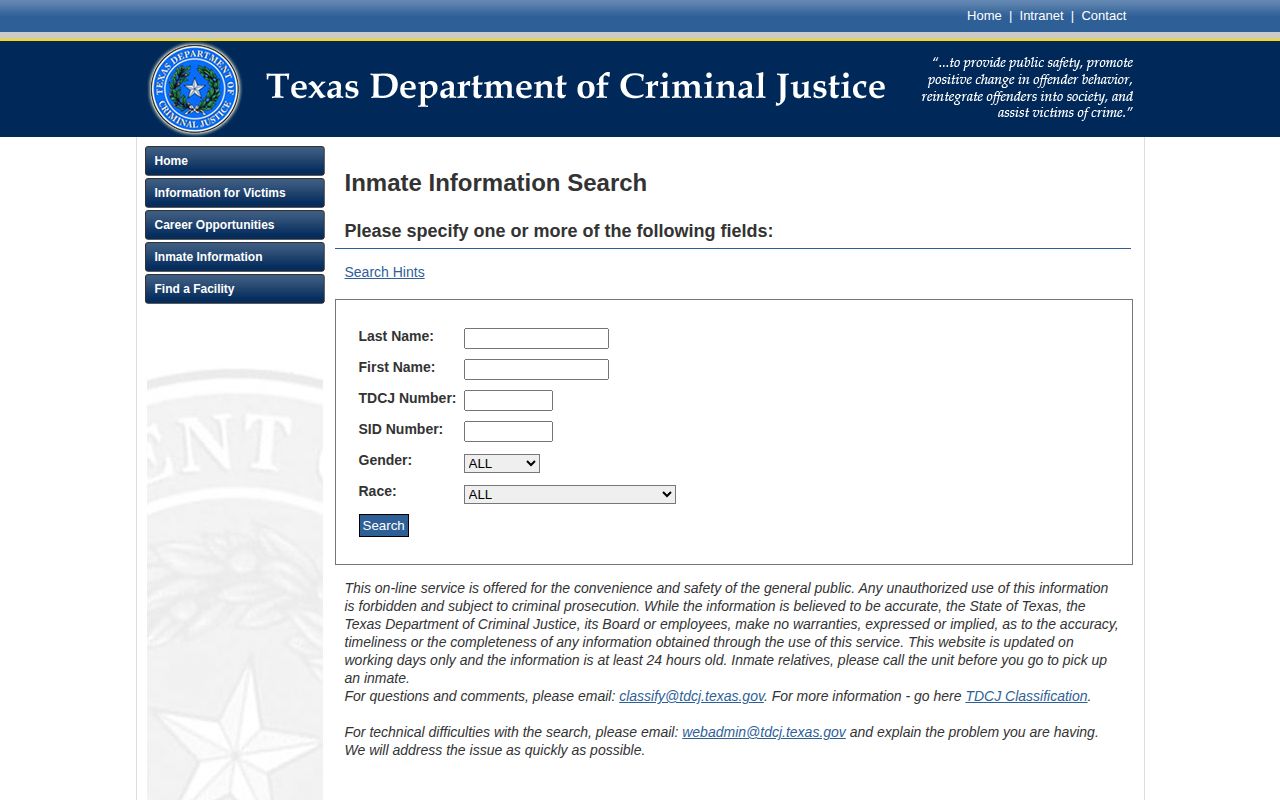
The resulting status must be read beside its label and the date checked. If no former record appears, use TDCJ inmate-information staff rather than conclude there was no state history.
Duval County Recent Release Limits
No official Duval County online roster, released view, rolling 24-hour list, 72-hour list, public update schedule, archive period, or sheriff app was found in the research sweep. The accurate route is dispatch for a named person, followed by a dated request for an existing booking and release log. Ask whether each row is a community release or transfer.
The official sheriff contact page demonstrates the local contact route and the absence of a linked public feed.
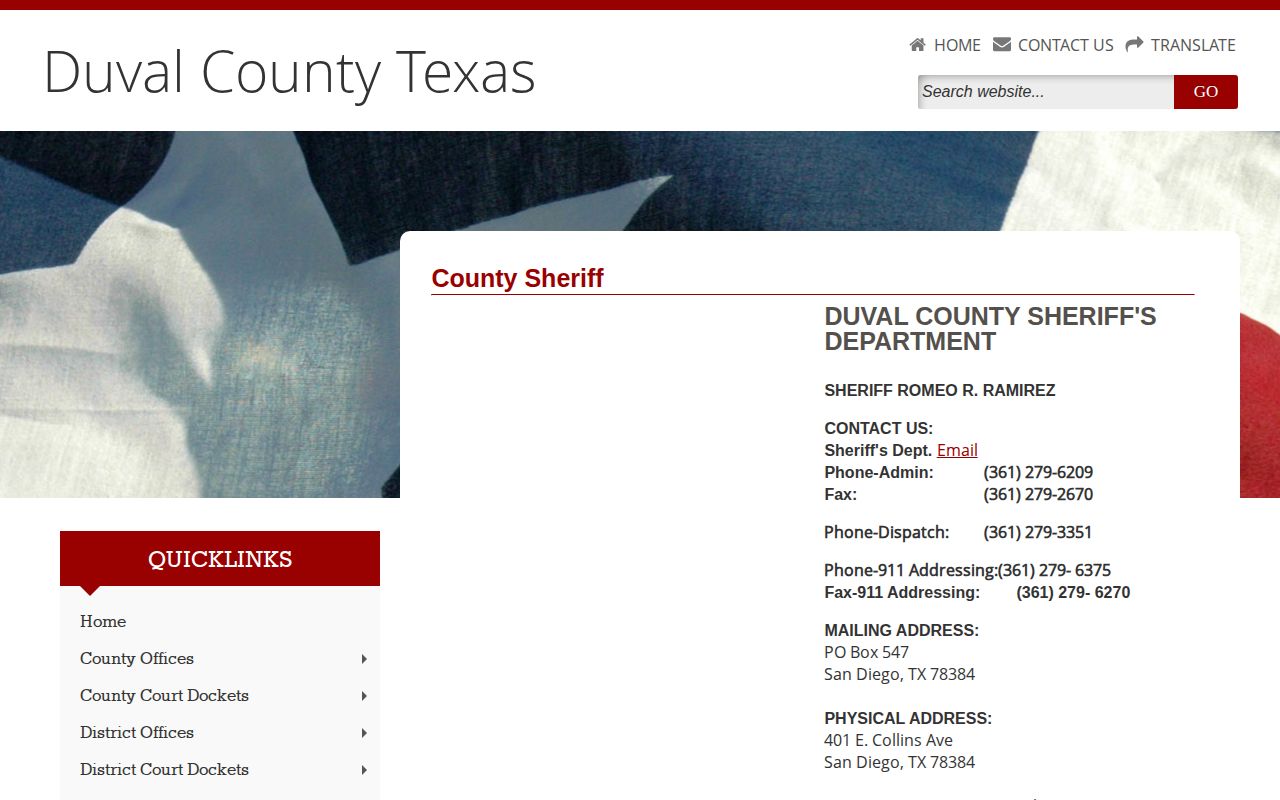
Use the published Texas address and 361 area code to avoid Florida results. A missing online photo or name does not establish release.
Getting Home After Duval Release
Duval County lists REAL Transit as a public transportation resource. REAL serves Duval and other Coastal Bend counties, with general weekday service from 5 a.m. to 8 p.m. The provider requests advance reservations, including 24 hours for many trips and 48 hours for out-of-town travel. Same-day service depends on capacity.
REAL Transit information may help plan a trip after community release. No source confirms a stop or jail-gate pickup at 401 E. Collins, so transportation should be arranged only after the release location and time are confirmed.
Duval Release Statistics Explained
A TDCJ FY2022 report counted five state-system releases by Duval County of conviction: four prison releases, no state-jail releases, and one SAFP release. This is a historical TDCJ measure. It is not the number released from Duval County Jail, and it does not show that those people left from a facility inside the county.
No reliable annual count or average stay for the Duval County Jail was found. The state figure must not be used as local jail throughput.
Duval Release IDs and Corrections
TDCJ's Reentry Program says eligible people can receive help obtaining replacement Social Security cards, certified birth certificates, and state identification before release. This is a state reentry service, not proof that a document was issued to a named person. For an error in a TDCJ time or release field, contact Classification and Records at (936) 437-6231 or classify@tdcj.texas.gov and identify the exact disputed field.
The TDCJ Reentry Program describes the identity-document help. Preserve dated copies of the search result, judgment, and release certificate when seeking a correction.
Duval Court Dockets and Release
Duval posts separate County Court and District Court docket archives. The County Court archive includes an “In Jail Supplement,” while a March 2026 district docket separates jail and non-jail cases. These are docket groupings for a particular setting, not release certificates.
Search both the County Court dockets and District Court dockets, then obtain the signed bond, dismissal, judgment, sentence, or discharge order from the proper clerk. The sheriff or TDCJ custody record still establishes the operational release.
Duval Parole and Probation Records
TDCJ Parole Division supervises parole and mandatory supervision. The Board of Pardons and Paroles makes release and revocation decisions. Court-ordered community supervision is a separate county CSCD path. Verify parole through the TDCJ record and assigned office; verify probation through the signed Duval judgment and department named in that case. An absent online record does not prove supervision ended.
Duval Release Alerts and Transfers
Texas moved county notification from VINE to Texas IVSS-Counties in 2025. The portal must show Duval participation before it is treated as a local source. TDCJ maintains a separate IVSS for prison, parole, Board, release, and discharge events. A person transferred from the county jail into state custody may require the state layer.
BOP's locator can retain a release date for many former federal prisoners. “Not in BOP custody” is broader than community release. ICE's locator covers qualifying current detainees and some recent releases, while U.S. Marshals movements may require court and agency confirmation. No federal or ICE detention center was verified inside Duval County.
Where Duval Release Status Appears
Match the record to the custodian that last held the person. Each database answers a narrower question.
| System | Still held | After release |
|---|---|---|
| Duval jail | Confirm with dispatch | Sheriff release entry and court file |
| TDCJ | Unit and current status | Release, parole, or discharge data when available |
| BOP | Federal locator status | Historical release wording and date for many records |
| ICE | Qualifying current civil detention | Limited recent-release window |
No one system proves freedom from every hold. Follow transfers into the receiving agency.
Duval County Release Facilities
Custodian identification is especially important in Duval because the county jail and the 612-capacity Glossbrenner state treatment facility operate under different systems. Use these exact facility paths:
- Duval County Jail / Duval County Sheriff's Department jail: local custody, verified with sheriff and court records.
- Ernestine Glossbrenner Unit: TDCJ treatment placement and state release route.
- Other Texas Department of Criminal Justice units: statewide prison, state jail, and treatment custody.
- Federal Bureau of Prisons institutions nationwide: federal sentence records.
- ICE detention network / non-ICE contract facilities: civil immigration custody.
- Municipal law-enforcement holding in San Diego, Freer, Benavides or other local jurisdictions: short-term local holding.
A December 2025 jail-standards notice provides facility history for the county jail, but it cannot establish any named person's release. Glossbrenner departure may lead to aftercare, supervision, another unit, or another detainer rather than full discharge.
Duval Release Proof Packages
Use several records when the result matters. For a county release, pair the sheriff's release event with the signed court or bond record and an IVSS event when available. For a state release, pair TDCJ status with a Board decision when parole applies and confirmation from the supervising office. For a federal release, compare the BOP historical result with the federal docket or direct agency response. These combinations reduce errors caused by stale screens, same-name matches, transfers, and labels that describe only one custodian.
Record the date each source was checked. Custody and supervision can change after a valid record was created. The goal is to identify the exact event, authority, time, and destination, then confirm the next custodian when the entry shows a transfer.